
Orientation text
PREVENTED LOVE
Nassia Linardou
In the first lesson of his seminar on Anxiety, referring to Aristotle, Lacan argues that “the best there is on the passions is caught in the net, the network, of rhetoric.”[1] He makes his own net with the signifiers he brings to the blackboard, trying to catch anxiety. He takes his cue from Freud's Inhibitions, Symptoms and Anxiety. He breaks down inhibition into difficulty on the horizontal axis and movement on the vertical axis of coordinates.
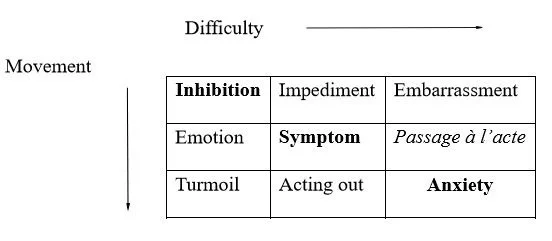
Lacan wishes to avoid the learned word inhibition. He intends to remain on the very ground of experience. He brings in the word impede (empêcher), which patients use when they feel inhibited and inscribes it in the column of the symptom. “To be impeded is a symptom,” he says. Turning to etymology, he points out that impedicare means “to be ensnared.” Something impedes, “not the function […] but the subject.” But Lacan immediately points out that “the snare in question is narcissistic capture.”[2] It introduces a limit as to what can be invested in the object: “The impediment that arises is linked to this circle that makes for the fact that, with the same movement by which the subject advances towards jouissance, that is to say, towards what is furthest from him, he encounters this intimate fracture, right up close, by letting himself be caught, along the way, by his own image, the specular image. That's the snare.”[3]
Let us therefore posit that prevented love is a love-symptom, where, turned towards the object, the subject in love finds himself ensnared and limited by his image. In the last two lessons of Seminar X Lacan returns to the double-entry matrix. He focuses on the constitution of the obsessional's desire and its relationship to anxiety. The elaboration of anxiety, as Jacques-Alain Miller developed at length in his Course in 2004, is already well advanced. The object a presents itself as the residue and cause of the signifying operation. It cannot be specularised.
In his reference chart, Lacan inscribes a not being able in place of the impediment. The subject, in this respect, “is very much impeded from abiding by his desire to hold back.”[4] This is expressed in what emerges in the obsessional as compulsion, here the compulsion to doubt. In his search for the primitive trace of the object, he is caught up in the to-and-fro of the signifier. But the road back to the first object is correlated with anxiety. Harboured at the core of desire, especially masculine desire, which is structured around the intermediary of an object, anxiety separates desire from jouissance.
Here the ambiguity of the function of love comes into play in the obsessional subject. An idealized love in which the Other, the woman on this occasion, becomes this exalted object that represents the negation of his desire. What the obsessional really engages of himself in this love is “the last object that his analysis can reveal [...], namely, the object of excrement […]”[5] The love that assumes for him the form of an exalted bond is merely the veil of the masked object a. It is the love of a certain image that he gives to the other and that he expects to be loved for. Maintaining this image of himself is “what chains the obsessional to maintaining a remote distance from himself, which is precisely what it is so hard to reduce in the analysis.”[6] This narcissism of the image prevents the crossing that the access to a love rooted in the object of the drive requires. Lacan occasionally recalls the overly exalted feelings of Prince Hamlet, which he likens to courtly love. When it appears outside the field of strictly cultural references, “courtly love is on the contrary”, he points out, “the sign of some shortcoming, some shirking, faced with the difficult paths that gaining access to a true love implies.”[7]
What, then, is true love? Lacan points to bereavement as an indication of this. Mourning is the work required of Hamlet to restore the power of his desire. It is “a labour that is carried out to maintain and sustain all these painstaking links with the aim of restoring the bond with the true object of relation, the masked object, the object a […]”[8] This is the condition for a substitute to be given. In this connection, Lacan evokes, not without some irony, the adventure recounted in the film Hiroshima Mon Amour, where it turns out, in the end, that “any old irreplaceable German can immediately find a perfectly valid substitute in the first Japanese man she comes across.”[9]
In another configuration, a patient returns to Greece captured by her love for a man who shares the political ideals of her expatriate family. “His body is my homeland,” she tells me to explain the intensity of the attraction that binds her to this ladies’ man who anguishes her and makes her suffer. Her work in analysis led her to discover what the family ideal-symptom prevented her from seeing, namely the erotomaniacal note that was the root drive of her love: to be the only one who could get this man out of his torment, particularly his alcoholism. The body as homeland referred to another body: the ravaged body of the anorexic-bulimic that was her mother, whom she wanted to help in the place of her impotent father. Separated from this devastating orality, she was able to accept other love substitutes in her life and envisage motherhood.
We could also mention Anton Chekhov's hero in the short story “About Love,” written based on his experience of love with the writer L. A. Avilova. The hero is unable to take the step of declaring his love for the young married woman and mother with whom he has fallen in love. Prevented by moral ideals from admitting their love, the two lovers gradually plunge into the discomfort of emotional unhappiness. It is only at the threshold of the separation imposed by life that the step is taken: “When our eyes met, moral strength abandoned us both. I took her in my arms [...] –– oh, how unhappy we were! –– I confessed my love for her and, with a burning pain in my heart, I realized how unnecessary, how petty and how deceptive all that had hindered us from loving each other was”.[10]
References
[1] Lacan, J., The Seminar of Jacques Lacan, Book X: Anxiety, ed. J.-A. Miller, trans. A.R. Price, Cambridge: Polity, 2014, p. 14.
[2] Ibid., p. 10.
[3] Ibid., p. 11.
[4] Ibid., p.319.
[5] Ibid., p.322.
[6] Ibid.
[7] Ibid., p.334.
[8] Ibid., p.335.
[9] Ibid.
[10] Chekhov, A., “About Love,” author’s translation.